- Tel: +86 150 0312 5825
- E-mail: l.wang@sino-marble.com

Fluted marble tile is the newest line in our marble tile range, and it is easy to misread at first glance. The grooves look carved, and the surface looks like decoration added on top of the tile. Neither is true. The grooves are cut into the marble tile itself, and the brushed finish takes the shine off, so the surface catches light and shadow instead of reflecting it.
The range comes in eight looks. Five carry a square grid groove: Beige Veined, White Veined, Green Veined, Black, and Beige Speckled. Three carry a long brick groove: Beige Speckled, Black, and Green Veined. Same idea, two rhythms. The grid reads classic. The brick reads modern.
This article explains what fluted means, how the brushed finish behaves, where the tile works best, and what to plan for cleaning and grout before you order.
Fluted means grooved. Parallel grooves are cut into the face of the marble tile, so the surface has ridges and valleys instead of one flat plane. Light hits the ridges and falls into the valleys, which is what gives a fluted wall its depth. Move past it and the wall changes. Stand still and it holds.
Three things it is not. It is not 3D tile. There is no raised decoration glued or printed onto the surface. It is not mosaic. Each piece is a marble tile, not a sheet of small pieces on mesh. And it is not carved decoration. The groove is the tile itself, cut in the factory, so every piece in the batch carries the same rhythm.
That matters when you order. A flat tile hides small differences between pieces. A grooved tile shows them, because the light reads every ridge. Ask for photos of the actual batch laid out together, not a single cropped close-up. A full lay-out shows whether the grooves line up from piece to piece.
Brushing takes the shine off the marble. A polished tile reflects the room. A brushed tile softens it. The surface stays matte, the veining stays visible, and fingerprints and water marks show far less than they do on a polished face.
That is the practical reason to pair fluting with brushing. Grooves already add shadow. A polished groove would throw hard reflections back at the eye. A brushed groove keeps the light calm, so the wall reads as texture rather than glare.
Brushed is also forgiving in daily use. A scuff or a water spot that would stand out on a polished surface blends into a brushed one. The stone still needs sealing, as all marble does, but the finish itself does less to advertise every touch.
Fluted tile earns its place where the light hits. Three spots suit it best.
A feature wall is the first. Put it where daylight or a wall light runs across the surface, and the grooves do the work. On a flat wall with flat light, the same tile reads as plain stripes, so save it for a wall that gets light.
A kitchen backsplash is the second. A backsplash is a small area viewed from close up, so texture shows. The grooves add movement without a busy pattern, and the tile suits kitchens where the countertop is plain and the wall is meant to carry the design. Seal it before first use, as with any marble backsplash, so oil and steam have a sealed surface to sit on.
A shower accent is the third. Use it as a band or a single wall, not as a whole shower floor. The grooves give the eye something to follow, and the brushed finish keeps the surface from glaring under bathroom light. For any wet use, ask your supplier about sealing and grout before you order, and confirm it in writing.
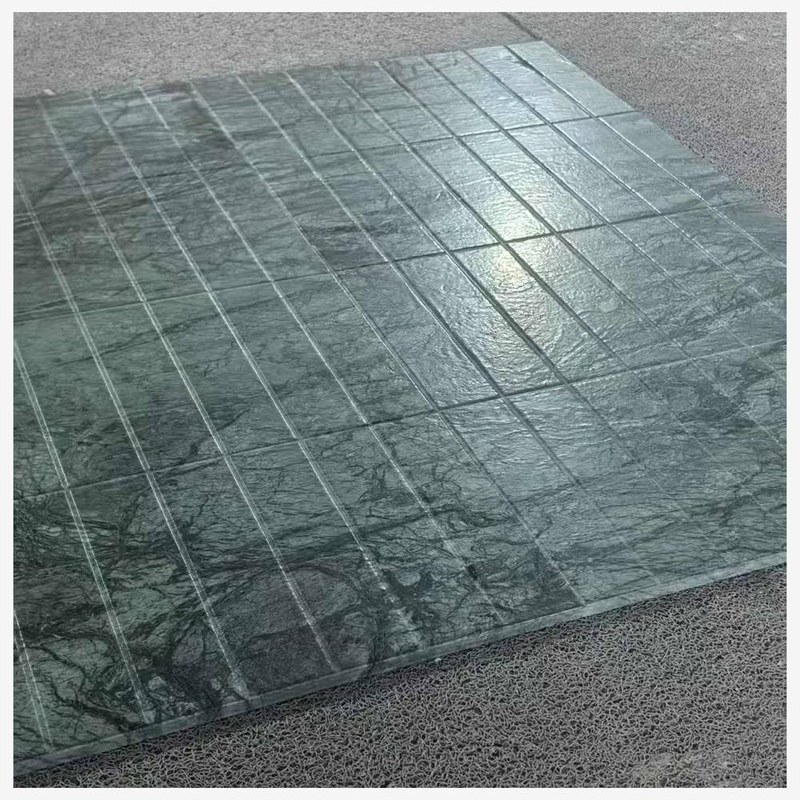
Grooves collect what flat tile does not. Dust settles in the valleys, and grout residue hides there too. Plan for that before the tile goes on the wall, not after.
For daily cleaning, use a pH neutral cleaner and a soft cloth, and run the cloth along the grooves rather than across them. A soft brush reaches the valleys a cloth misses. Avoid acidic cleaners and abrasive pads, which damage both the sealer and the stone surface.
Grout color changes the whole wall. A grout that matches the stone keeps the surface calm and lets the light do the talking. A contrasting grout turns every groove into a line and makes the wall busier. Ask your supplier what grout color they recommend for each colorway, and pass that recommendation to the installer before the job starts, not during it.
Seal the stone and the grout after installation, then reseal on a schedule. How often depends on use, so ask your supplier for a starting point and adjust from there. The one rule worth passing to your customers: never leave a fluted wall unsealed in a kitchen or a bathroom. A stain that sets into a groove in the first week is far harder to remove than one caught on a sealed surface.
Put these in your first email to any new stone supplier: Which fluted looks do you carry, in grid groove and in brick groove? Can you send photos of the actual batch, laid out together, so I can see how the grooves line up? What grout color and sealer do you recommend for each colorway? Can the tile be used as a shower accent, and what sealing does that need? Can you send a sample piece first, so the customer can see the groove and the brushed finish in their own light?
A supplier who answers all five plainly is a supplier you can build a line around. One who answers with adjectives instead of specifics is a sample order, not a container order.
Want photos and pricing on the fluted marble tile line? We can quote FOB, or landed to your warehouse, whichever is easier for you to compare.
— The Sino-Marble Team