- Tel: +86 150 0312 5825
- E-mail: l.wang@sino-marble.com

French Pattern is one of the most searched stone terms — and one of the most misunderstood. Buyers ask for it by name, suppliers quote it by name, and both sides sometimes mean different things. Here's the whole story in plain language.
First, the most important point: French Pattern is not a type of stone. It is a laying pattern — a set of several sizes of rectangles and squares that fit together in a fixed, repeating combination. You can have French Pattern in marble, limestone, travertine, or sandstone. The stone is one choice; the pattern is another.
If a quote just says "French Pattern" without saying which stone, which sizes, and which thickness, it doesn't actually tell you what you're buying.
A French Pattern set is sold as a combination, not as individual pieces. Several rectangle and square sizes are packed together in a fixed ratio, and the combination repeats across the floor or patio. That repeating mix is what gives French Pattern its classic, varied look — no monotonous grid, no random scatter.
Before you order, ask for two things:
The pattern diagram — a drawing showing how the sizes fit together.
The ratio table — how many pieces of each size are in one set, and how many square feet one set covers.
These two documents are the product definition. Without them, you're ordering a name, not a pattern.
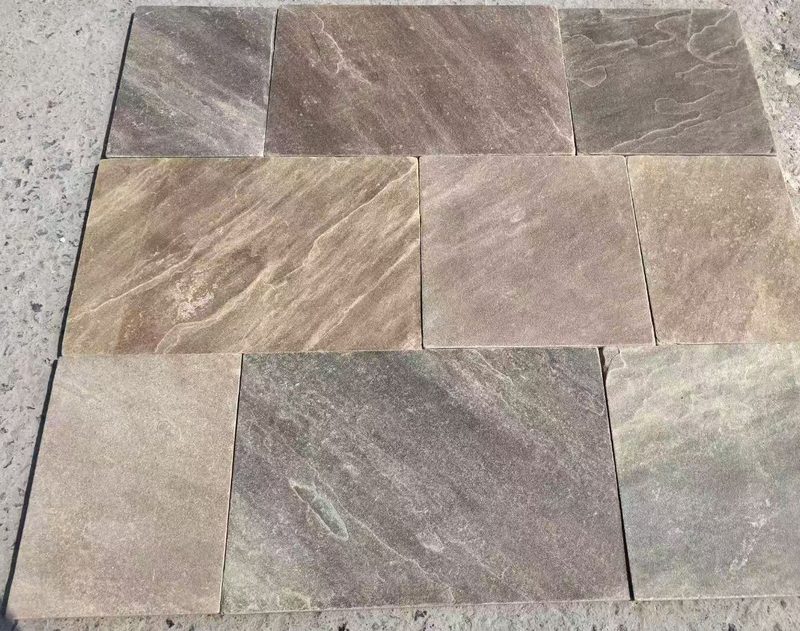
When you see "French Pattern 30" or "French Pattern 12," the number is the thickness of the set in millimeters: 30 is a 30mm thick set, 12 is a 12mm thick set. Same pattern, different thickness — and thickness decides where it goes:
30mm sets suit outdoor paving, patios, and areas with heavier use. The extra thickness handles load and uneven ground better.
12mm sets suit interior floors and lighter-use areas, where a thinner stone is easier to lay and easier on the budget.
Ordering the wrong thickness is the classic French Pattern mistake: a 12mm set under a car, or a 30mm set where a 12mm would do. Match the number to the job before you compare prices.
Here is the trap: French Pattern combinations vary from factory to factory. Two suppliers can both sell "French Pattern" with different size mixes and different ratios. The finished floor will look different, the pieces per set will differ, and the square footage per set will differ.
That is why the pattern diagram and ratio table from section 2 are non-negotiable. Confirm them before you pay, not after the container arrives. And if you're matching an existing floor, send your supplier a photo and the measurements of what you already have — "French Pattern" alone is not enough to match it.
Pattern diagram and ratio table — the exact size mix and pieces per set.
Square footage per set — so you can calculate how many sets the job needs.
Thickness — 30 or 12, matched to the application.
Calibration — are the pieces calibrated to a consistent thickness? Uncalibrated pieces mean an uneven floor and a harder installation.
Overage — order 10–15% extra for cuts, breakage, and future repairs. Matching a pattern set from a later batch is never guaranteed, and color varies from lot to lot, so approve the current batch with photos before packing.
A 30mm set weighs far more per square foot than tile, and that changes the logistics. A container can hit its weight limit before it's full — confirm with your supplier and freight forwarder how many sets actually fit, not just how many crates. Packing must be rigid wooden crates, and ask for a photo of the packed crates plus a set count per crate so you can verify on arrival.
That's the short version. French Pattern rewards buyers who confirm the diagram, the ratio, and the thickness — and punishes everyone who orders the name alone.
If you're planning a French Pattern order and want a second pair of eyes on a quote or a pattern diagram, send it over. We look at this stone every day.
— The Sino-Marble Team


