- Tel: +86 150 0312 5825
- E-mail: l.wang@sino-marble.com

A plain mosaic is a pattern the factory already makes. A waterjet mosaic is a pattern you ask for. A high-pressure jet of water cuts the marble into whatever shape the drawing calls for, and the pieces are laid together by hand into a sheet, a medallion, or a whole floor.
It is the closest thing in stone to printing. But it is still stone, and it still follows the rules of stone: the batch matters, the grout matters, and the drawing has to be right before the cutting starts. Here is how it works, and what to check before you order.
A waterjet cuts stone with water at very high pressure, mixed with a fine abrasive. There is no blade and no heat, so the edge stays clean and the stone does not crack from the cutting itself. That is what makes it different from a saw: a saw cuts straight lines, and a waterjet cuts curves, points, and shapes as fine as the drawing allows.
The pieces are cut from marble tile, then assembled on a mesh sheet, most often 12x12 inches, so the installer can lay a whole pattern at once instead of setting hundreds of pieces one by one. A medallion, a border, a logo, or a repeating floor pattern all arrive the same way: as sheets, ready to lay.
Waterjet is not a different kind of stone. It is a different way of cutting the same stone. The marble is still marble, with the same veining, the same variation from batch to batch, and the same need for sealing.
The starting point is a drawing. It can be a sketch, a photo of a floor you like, or a CAD file from your designer. The factory turns it into a cutting plan, and that plan is what you approve before anything is cut.
What buyers usually ask for falls into three groups. A medallion is a single round or square centerpiece, often for a foyer or a shower floor. A border is a repeating strip that frames a room or runs along a wall. A full pattern is a repeating design that covers a whole floor or wall, where every sheet is the same and the pattern continues from one sheet to the next.
The stones in the pattern can be two, three, or more colors. White and black is the classic pair. Add a grey or a gold, and the pattern gets richer, but every extra stone is another material to match, another batch to keep together, and another line in the price.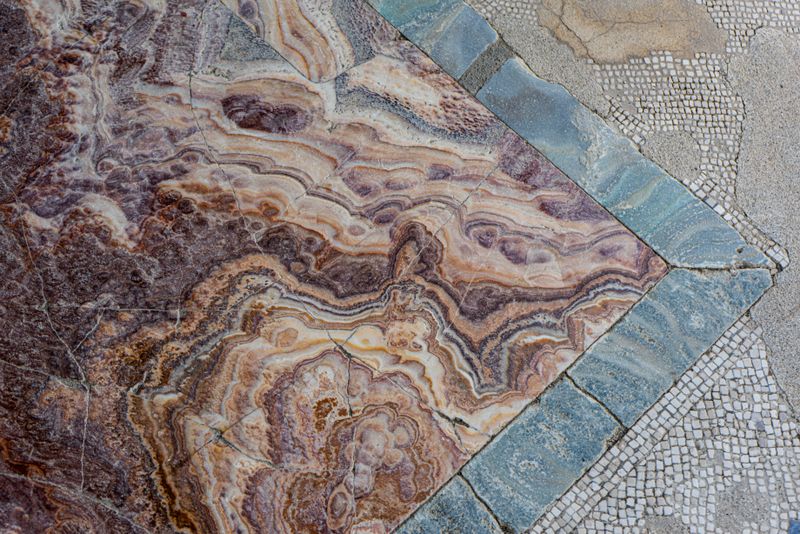
There is no single price for a waterjet mosaic, because the price is the pattern. Four things move it.
The first is complexity. A pattern with a few large pieces costs less than a pattern with hundreds of small ones. Every piece is a cut, and every cut takes time. Small pieces also mean more grout lines, and more grout lines mean more work for the installer.
The second is the number of stones. Each color in the pattern is a different marble, cut from a different block. Two colors are straightforward. Four or five colors mean four or five materials to source, match, and keep in one batch.
The third is the size of the job. A single medallion carries the full cost of the drawing and the setup, spread over a small area. A whole floor spreads the same setup over a large area, so the price per square foot comes down. Small orders are dear per piece. Large orders are not cheap, but they are cheaper per piece.
The fourth is the finish. A polished waterjet mosaic shows the pattern at its sharpest, and it shows every fingerprint too. A honed finish is softer on the eye and better underfoot in a wet room. The finish does not change the cutting, but it changes the look, and it should be decided before the order, not after.
A stock mosaic ships on a regular production schedule, about 2 weeks for a regular order. A custom waterjet mosaic takes longer, because the work has more steps: the drawing, the approval, the cutting, and the assembly. None of these steps is long on its own, but they run one after another, and the cutting cannot start until the drawing is approved.
The full journey from order to jobsite usually runs 6 to 10 weeks, and a custom waterjet order sits at the longer end of that range. The way to keep it on time is to approve the drawing quickly and completely. Every change after approval sends the job back to the start of the cutting plan, and the calendar moves with it.
Ask for the lead time in writing, with the drawing approval step named as a date. A quotation that promises a fast delivery without mentioning the drawing is promising the second half of the job and forgetting the first.
Waterjet mosaic earns its price where the pattern is the point. A foyer medallion that guests see the moment they walk in. A shower floor where the pattern shows through the glass. A backsplash where a border turns a plain wall into a finished one. In these places the cutting is the feature, and the cost is easy to justify.
It also works as an accent rather than a whole room. A single medallion in the middle of a plain marble floor. A border around a plain field tile. A small panel behind a stove. The accent gives the room its character, and the plain tile around it keeps the budget in check.
Where it does not pay is a place nobody looks at. A storage room, a service corridor, a floor that will be covered by furniture. The pattern is still there, and the price is still there, but no one sees it. Save the waterjet for the room that gets looked at.
First, approve the drawing in writing, with the colors named. A sketch and a nod are not an approval. The drawing should show the pattern, the stones, and the sizes, and both sides should hold the same version.
Second, confirm the stones. Each color in the pattern should be named, and the batch for each color should be one batch for the whole job. Ask for a dry lay-out photo before shipment, so you can see the real colors together before the stone leaves the factory.
Third, check the sheet size and the grout. Most waterjet mosaic arrives on 12x12 sheets. Ask how wide the grout joints will be, and what grout color the factory recommends. Tight joints show the pattern. Wide joints break it up.
Fourth, confirm the lead time and the validity in writing, with the drawing approval as a named step. A custom order without a drawing date is an order without a schedule.
Fifth, ask for a sample of the pattern before the full order, even a small one. A single sheet tells you more about the real colors, the real joints, and the real finish than any drawing can. It is the cheapest insurance in the whole order.
A waterjet mosaic is stone cut to your drawing, and that is exactly what makes it worth ordering and worth checking. The pattern is yours, the stones are real, and the price follows the pattern. Approve the drawing, confirm the batches, and the floor will look the way the drawing promised.
Tell us the pattern you have in mind, or send a photo of a floor you like. We will turn it into a cutting plan, confirm the stones and the lead time with you, and send a sample sheet before the full order.
— The Sino-Marble Team